
 español



Performance analysis and optimization of high-voltage energy harvesting current transformer (1)
In recent years, as power grids have increasingly advanced toward intelligent and automated operation, real-time monitoring of power systems—such as insulation monitoring of transmission lines, fault location in distribution networks, and overhead line icing detection—has become a critical focus. Given the high voltage levels of transmission lines, monitoring equipment is often exposed to prolonged high-voltage and strong electromagnetic field conditions. To ensure the reliable operation of such equipment, it is essential to provide a highly stable power supply.
Common power supply methods for grid monitoring equipment include battery-based power, solar power, laser power, hybrid power supply, and current transformer (CT)-harvested power.
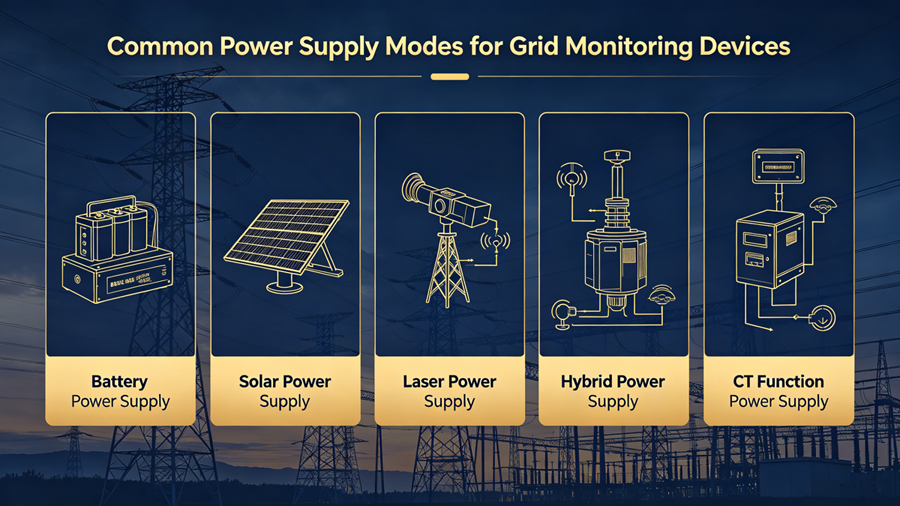
CT power supply, based on electromagnetic induction from transmission line current, features a simple design, compact size, and low cost. These attributes make it the most widely adopted and popular power supply solution currently available.
Several technical challenges currently exist in CT-based power harvesting:
Insufficient power under low bus current conditions, resulting in a large power dead zone;
Magnetic core saturation under high bus current conditions, leading to distortion of the output voltage waveform;
Significant fluctuations in bus current, which introduce design difficulties in balancing performance between low-current and high-current operation.
Existing Mitigation Strategies
In response to the above issues, various research efforts have proposed and implemented different solutions to partially overcome the limitations of CT energy harvesting:
Combining lithium batteries with CT power supply can, to some extent, address power availability under low-current conditions;
Adopting a dual-core parallel structure with a bypass circuit to extend the operational range of the CT;
Employing a dual magnetic circuit structure with photovoltaic capacitor compensation to reduce the power supply dead zone;
Optimizing magnetic core parameters and adopting a multi-turn winding strategy to prevent core saturation;
Designing a power control circuit using a bidirectional thyristor to accommodate bus current fluctuations within a certain range.
Despite these efforts, the three fundamental issues outlined above remain unresolved.
Emerging Design Solution
Consequently, a novel design approach has been developed. In this design, the magnetic core features an open-gap configuration, which is the most parameter-optimized method for reducing the current dead zone. By analyzing the variations in load and the number of turns, a strategy combining multiple turns with parallel resistors is employed to suppress saturation.
This solution effectively overcomes the challenge of stable power supply under high-current conditions, while also taking low-current power supply requirements into consideration. It offers the advantages of easy installation, straightforward control, and low design cost.
In the following section, we will further analyze: the energy harvesting system based on an open-gap magnetic core, including the optimization of core parameters, the design of anti-saturation measures, and experimental validation of energy harvesting performance.
Categorías
Nuevo blog
Para obtener consultas sobre nuestros productos o su lista de precios, por favor, déjanos a nosotros y estaremos en contacto dentro de las 24 horas.


 Llama a :
Tel : +86-20-85649266
Fax : +86-20-85649263
 Envíanos un correo electrónico :
Correo electrónico : derful@coilcore.com
 Dirección :
A402 Zhuangyuangang Industry Park, No.186 Qishan Road, Tianhe District, Guangzhou 510663
© Derechos de autor: 2026 Guangzhou Amorphous Electronic Technology Co.,ltd. Reservados todos los derechos. 粤ICP备2021057165号

Red IPv6 admitida
Enlaces amistosos:
Precision Air Conditioning wellav syblecode gangyuantech PCB Board eavisionag PLC liantronics kenmold 5gplc Mu Metal Core Manufacturer PLC modules liantronics Customized Filter Supplier tslcd szgilong addbuyplc ifpdtech dtechelectronics sekloadcell naturollsensor smarts-electronics bnttablesocket mbluetech esdled oscymonitor current sensor zhicetemptech benchu-group esdled